


10,000 simulation-ready assets, with geometry, appearance and physics varied independently.
Generative meshes are double-layered, fragmented and atlas-packed — unusable as cloth. We expand clean templates instead; every variant records its seed and recipe and passes the same simulation-stability check.
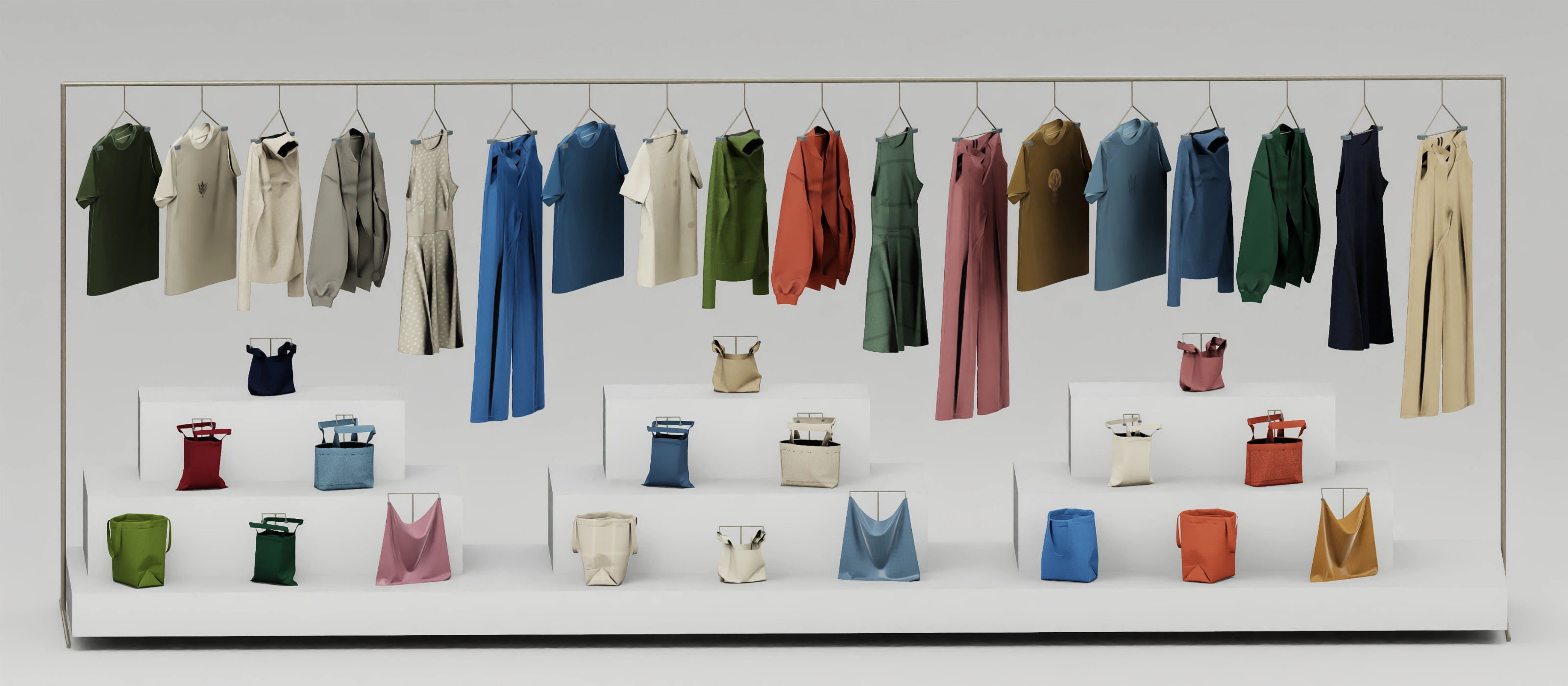
Render materials and printed patterns.
Semantic regions deform; the rest pattern is rebuilt under seam-length constraints.
Density, thickness, anisotropic stretch, shear, bending, damping, friction.
Six tasks covering five physical regimes of fabric manipulation.
Long-horizon folding with self-contact, recovery under self-occlusion, momentum transfer in flinging, friction-limited holding without attachment, and a volumetric bag that carries its load. Success is outcome-based: any behavior that reaches the target state earns credit.
Fold T-shirt
Contact-driven simulation. No attachment, no penetration, stable grasps.
Grasp–hold–release test: the same dual-arm trajectory that reliably grasps, holds and releases a T-shirt on the real Piper robot is replayed in four simulators, at 15 placements three times each. Only FabricBench succeeds in all 45 trials.
Higher sim-to-real fidelity on RGBench: 39% lower error than Isaac Sim PBD, 58% lower than PyBullet.
RGBench replays real bimanual fold and grasp-and-lift trajectories in simulation and scores fidelity by the Chamfer distance between the simulated and the real garment point clouds. Errors are averaged over seven garments; ours is the lowest in 13 of 14 garment–motion pairs. Baseline numbers are as reported by RGBench.
Two controlled axes. One factor at a time.
On the flattening tasks, the configuration ladder changes only how the cloth starts; appearance variants change only color and texture. Asset, camera and placement stay matched, 50 fixed-seed episodes per cell.
Leaderboard
VLA, WAM and imitation-learning (IL) policies, each trained on the same 200 demonstrations per task; 50 episodes per cell.
Task difficulty in simulation carries over to the real robot.
π0.5 checkpoints trained only on simulated demonstrations are deployed zero-shot on the real dual-arm Piper, 20 trials per task, with the camera placed as in simulation. Without training on FabricBench, the pretrained π0.5 succeeds in none of the real trials.
task difficulty, sim vs. real